
Reviewed · WALKING TOURS
British Architecture Walk, an immersive walking tour in Chennai
Chennai has a British architecture trail that you can follow on foot, and it is easier to read than you might expect. You start with railway landmarks, then move through civic buildings, and finish near the University of Madras, so the route feels like a guided timeline of the city’s colonial-era design. The real payoff is how clearly you can spot Indo-Saracenic influences and British-era style changes in everyday landmarks.
Two things I really like about this walk are the small group size and the fact that snacks are included at no extra cost. With a maximum of 15 people, your guide can actually explain what you are seeing instead of racing ahead. And with coffee or tea added to the mix, it is a practical way to keep energy up without turning the tour into a restaurant stop.
One consideration: it is a walking route that runs about 2 hours 30 minutes, so comfortable shoes matter. Also, some stops include admission while others do not, so you may need to follow the guide’s lead if a building is accessible but entry costs apply.
Key Things to Know Before You Go
- A tight 2.5-hour loop that strings together major British-era landmarks from Egmore to the University of Madras area
- Max 15 travelers, which makes it easier to ask questions and get personalized pacing
- Free snacks plus coffee or tea, so you are not paying extra to stay fueled
- Admission included at several key stops, while a few others are listed as not included
- Optional hotel transfers if you want the least-effort start and finish
- Local guide leadership, with guides like Hareesh and Satish praised for making history feel clear and friendly
British-Era Architecture in Chennai That Actually Feels Coherent
If you have ever looked at Chennai and thought, Yes, this city has layers, but it is hard to connect them, this walk helps. You are not just looking at old buildings, you are walking from one landmark type to another, which makes the story easier to understand. Railway architecture, public halls, government buildings, bridges, and university administration all show different design priorities.
The route is also smart because it mixes famous names with visually distinct styles. You will see British-era structures tied to governance and transport, then watch how local builders and architects adapted those influences into an Indo-Saracenic look. Even if you are not a design nerd, the changes are visible, especially around arches, domes, and the overall massing of buildings.
The walking format matters. Sitting in one place would not give you the same sense of how Chennai’s British-era landmarks are spaced through the city. By the time you reach the Marina side and the University of Madras area, the earlier stops start to click as part of one broader pattern.
More Walking Tours in Chennai
- Gods of Mylapore walking tour- tourism ministry approved company
★ 5.0 · 267 reviews - Georgetown heritage walking tour in Chennai about the founding of Chennai
★ 5.0 · 144 reviews - Mahabalipuram walking tour by tourism ministry approved company
★ 5.0 · 102 reviews
Price and Time: Is $55 Good Value for This Walk?
At $55 per person for about 2 hours 30 minutes, this is not the cheapest thing on the menu in Chennai. But you do get a lot of structure for your money: a local guide, coffee or tea, snacks included, and a route packed with major buildings.
A big part of the value is the combination of guidance plus selected admission. Several stops list admission tickets as included, while others are not. That means you are more likely to get inside or properly view key architectural moments instead of treating everything as an exterior photo stop. You also get a mobile ticket, which cuts down on on-the-spot friction.
You can also read the price against the group size. With a maximum of 15 travelers, your guide can spend real time explaining, and that tends to be where walking tours rise or fall. The standout reviews connect directly to this point, especially praise for guide style and explanation.
One practical note on timing: this tour is commonly booked about 29 days in advance on average. If your dates are fixed, it is worth reserving earlier so you have fewer compromises.
Meeting Point to Finish: How Logistics Affect Your Experience
This walk starts at Chennai Egmore, at Gandhi Irwin Rd, Egmore, Chennai, Tamil Nadu 600008. It ends near the University of Madras, at Navalar Nagar, Chepauk, Triplicane, Chennai, Tamil Nadu 600005.
That start-to-finish flow is convenient if you want to build a half-day around the Marina and the university area afterward. It also means you are not repeating the same streets just to get back where you began.
You can get optional pickup and drop-off if you choose it, which is a real help when you are juggling heat, crowds, or just wanting a smoother arrival. If you do not select transfers, the good news is that the tour is listed as near public transportation, so you should not feel stuck far from your route.
The tour runs as a small-group format with a local guide from 5 Senses Walks. Reviews highlight guide energy and clarity, and the practical details show up in small ways too, like being offered coffee on the way by guides such as Hareesh.
What You Gain from a Small Group Guide Like Hareesh or Satish
A walking tour lives or dies by explanation. Here, guides are a major reason people rate it so highly. Names that come up in praise include Hareesh and Satish, with both described as enthusiastic and full of details about the buildings.
What matters for you is not trivia for its own sake. The best explanation helps you look at the façade and instantly understand what you are seeing. For example, if you learn who designed a station and what style it was built in, you can spot the design logic without needing to be an architect.
I also like the way this tour spreads attention across the group. With a maximum of 15 people, your guide can pause for questions and adjust pacing without the tour turning into a line of hurried walkers. That is especially helpful when you are moving between railway architecture, civic buildings, and bridges where there is a lot happening around you.
And yes, the “small touches” count. Reviews mention guides treating the group to Indian coffee during the walk, which pairs nicely with the tour’s included coffee or tea and snacks. It turns a history walk into something that feels human, not mechanical.
A different shape of Chennai day:
- Mahabalipuram tour by Tourism Ministry approved company
★ 5.0 · 405 reviews - Mahabalipuram & Kanchipuram by tourism ministry approved company
★ 5.0 · 264 reviews - Chennai tour in car with guide-winner of traveller’s choice award
★ 5.0 · 258 reviews - Mahabalipuram Private tour from Chennai by car with guide and lunch by Wonder
★ 5.0 · 137 reviews
Egmore Station and Chennai Central: Railway Buildings as British Architecture
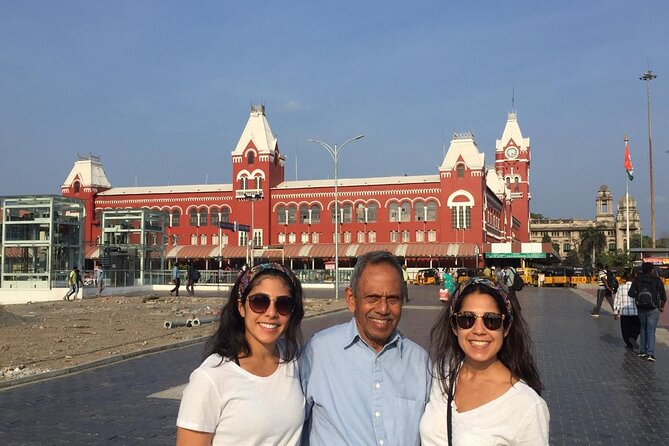
Your first stop is Chennai Egmore, including Egmore Railway Station. This is more than 100 years old and one of the early buildings built in Indo-Saracenic style. The design is credited to Henry Irwin, and there is a fascinating ambition behind it, planned to be larger than London’s Charing Cross station.
You will spend about 20 minutes here, and you should use that time to look at the “shape language” of the building. Indo-Saracenic is not just a decorative label. It is a way of mixing British planning and grandeur with local building forms. Egmore’s station setting also helps you see how transport architecture was treated like civic architecture.
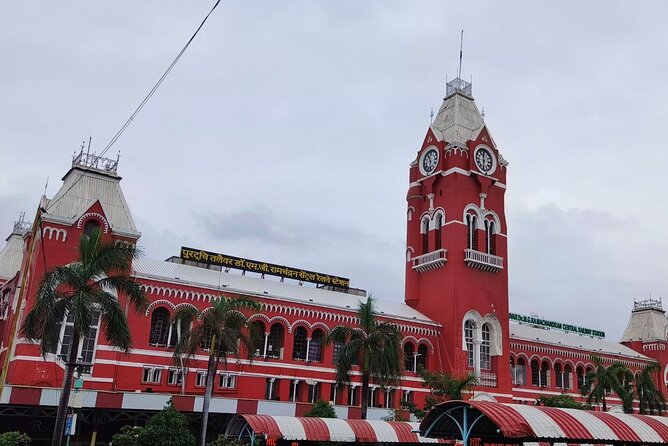
Next is Chennai Central Railway Station, with about 30 minutes. This one was built in 1873 in Gothic Revival style by British architect George Harding. Later changes by Robert Chisholm added a central clock tower and Travancore caps on the main areas.
This is a great stop for learning how British influence evolved rather than stayed frozen. Harding gives you the Gothic Revival foundation, then Chisholm’s modifications show adaptation. If you are photographing, consider a position that lets you capture both the overall façade and the clock tower area, because that tower is one of the easiest features to identify.
Admission is listed as included at both Egmore and Central stations, which makes these two stops especially worth leaning into during the walk. You will also likely see how busy these spaces are in real life, which adds a layer of realism to the architecture.
Victoria Public Hall and the Ripon Building: Civic Power in Stone
After the railway landmarks, you shift into public and government architecture. Stop three is Victoria Public Hall, about 20 minutes. It opened to the public in 1887 to commemorate the Golden Jubilee of Queen Victoria. The hall is named after the queen and was used for public meetings and other events.
Even if you do not go inside, this stop is valuable because it shows how colonial-era Britain used architecture to signal authority and public identity. Buildings like this are about more than hosting gatherings, they are about projecting legitimacy and permanence.
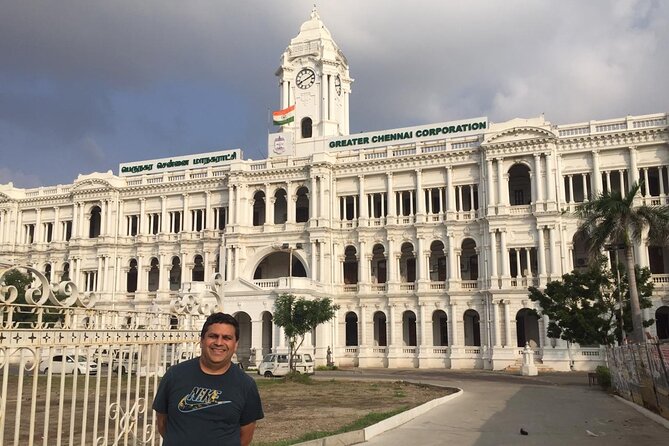
Next is the Greater Chennai Corporation Office area, continuing to the Ripon Building. This section is about 15 minutes, and admission is listed as not included. The Ripon Building was commissioned in 1913, designed by G.S.T. Harris and built by Loganatha Mudaliar, named after Lord Ripon, a Governor-General.
I like the way this stop connects names to places. If you know that the building is named after Lord Ripon, your brain starts linking the civic architecture to the political context that produced it. And the design details in Indo-Saracenic-adjacent buildings often act like visual receipts, showing how local craft and British aspirations met.
A drawback at these civic stops is simply time. With short windows, you need to listen closely and take quick notes rather than expecting a slow museum-style read. If you want the most out of this section, look for patterns in doors, windows, and how the structure transitions between ornament and practicality.
Southern Railway Headquarters and Napier Bridge: Movement, Crossing, Naming
Stop five is the Southern Railway Headquarters, about 15 minutes, with admission listed as not included. The building was completed in 1921 in Indo-Saracenic style, designed by N. Grayson and built by Samynada Pillai.
This is one of those stops where listening to the “who and when” helps your eyes. Completed in 1921, it sits later than many earlier British-era landmarks in the route, so it helps you see how style and institutional needs matured over time. Indo-Saracenic buildings from this period often feel more confident, like the architecture learned what worked.
Then you move to Napier Bridge, another about 15 minutes, and admission is included. Built in 1869 across the Coovum river, it is named after Francis Napier, the British governor of Fort St George. The bridge connects the Marina to Fort St George, and the name itself is a clue that you are not just crossing water, you are crossing history.
This is a strong photo moment because a bridge gives you lines, perspective, and context all at once. It also helps you understand how British authority and city planning were physically connected through infrastructure.
One small practical tip: if you want to capture the bridge plus the landmarks around it, plan to listen first, then step into position when your guide indicates what to look for. That way you do not miss the naming and historical context while you are busy shooting photos.
University of Madras Senate House and the Victory War Memorial
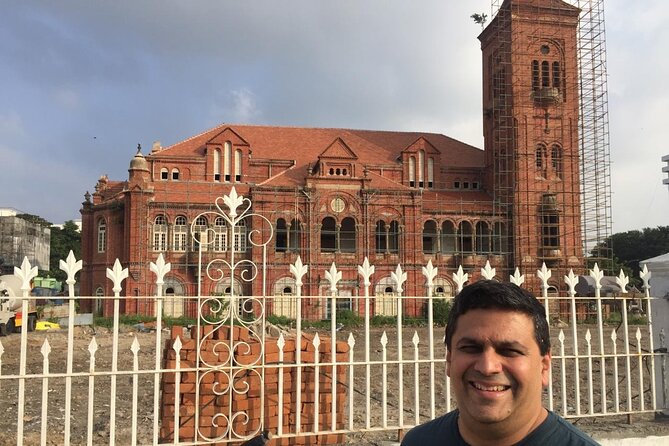
The final stretch is near the University of Madras area, and it blends academic administration with memorial architecture. Stop seven is the University of Madras, with about 15 minutes. The Senate House is the administrative center, located along the Marina Beach, constructed by Robert Chisholm. This is framed as a strong example of Indo-Saracenic style.
Chisholm shows up again after his work at Chennai Central. That repetition is helpful because it gives you a mental thread. If you have been noticing similarities in how features are handled across the route, this stop is where you can test your pattern recognition.
Admission is listed as not included here, so focus on external viewing and your guide’s explanation. If you time it right, you can also use the university setting to get a sense of scale. Unlike railway stations or civic halls, universities communicate a slower, more institutional identity.
Finally, stop eight is the Victory War Memorial, about 15 minutes, with admission included. It was formerly called Cupid’s bow and later became the Victory War Memorial, commemorating Allied victory during World War I from 1914 to 1918.
This is a memorable ending because it shifts your attention from architecture as function to architecture as memory. A memorial is a different kind of statement, and knowing the original name Cupid’s bow helps you see how the meaning of a site can evolve over time.
Tips for Getting the Most from the Walk
This tour is designed as a paced route, but your comfort can make it feel either smooth or stressful. Since you are on your feet for about 2 hours 30 minutes, wear comfortable shoes and keep your timing tight with the group.
Use the included refreshments strategically. Coffee or tea and snacks are part of the experience, so do not wait until you are already tired. A short snack break can help you keep attention during the middle stops when the city scenery gets busy.
Bring a simple photo approach. When you arrive at each stop, take one wide shot that shows the building’s overall look, then take two close-ups based on what your guide points out. Stations and civic buildings tend to have lots of detail, and it is easier to organize your photos if you anchor them to a few features like towers, arches, or window patterns.
Finally, plan your next move after the walk. Since you finish near the University of Madras area, you are already positioned for a later stroll around the Marina side.
Should You Book This British Architecture Walk?
I think you should book this tour if you want a guided way to understand British-era architecture in Chennai without getting lost in dates. The route is well structured, starting at Egmore, then moving through Chennai Central, civic buildings, a major bridge, and ending near the University of Madras and a World War I memorial.
It also makes sense if you value explanation style. The best reviews single out guides like Hareesh and Satish for turning history into something you can see. Add in the small group size and the included snacks and coffee or tea, and the tour becomes good value for a short, focused evening or half-day plan.
Skip it only if you prefer long, museum-style time at one site. This walk spreads attention across many stops, so you are trading deep time at one building for broad, connected understanding across the whole route.
If British architecture in Chennai is on your list, this is one of the cleaner ways to see it in a single sitting. You will finish with a stronger eye for style, and a better grasp of why these buildings are still so visible in the city today.
FAQ
How long is the British Architecture Walk in Chennai?
It is approximately 2 hours 30 minutes.
What is the price per person?
The price is $55.00 per person.
What is included in the tour price?
The tour includes a local guide, coffee and/or tea, and all taxes, fees, and handling charges. Snacks are also provided at no extra cost.
Is hotel pickup and drop-off available?
Pickup and drop-off are optional. If you select hotel transfers, they are included; otherwise, they are not included.
How many people are in each group?
The tour has a maximum of 15 travelers.
Where does the tour start and end?
It starts at Chennai Egmore (Gandhi Irwin Rd, Egmore) and ends at the University of Madras (Navalar Nagar, Chepauk, Triplicane).
Are admissions included to the stops?
Admission is included for some stops (such as Egmore Railway Station, Chennai Central Railway Station, Napier Bridge, and the Victory War Memorial). Other stops are listed as not including admission.
What ticket format do I receive?
You get a mobile ticket.
What is the cancellation policy?
You can cancel for a full refund up to 24 hours in advance of the experience start time, and free cancellation is available.
Latest reviews in from Chennai
- Marina Beach walking tour by tourism ministry approved company★ 5.0 · 45 reviews
- Following the foot steps of St Thomas in Chennai★ 5.0 · 45 reviews
- Private Peacock Trail Walking Tour in Mylapore★ 5.0 · 50 reviews
- Private Bazaar Trail Walking Tour in George Town★ 5.0 · 66 reviews
- Full-Day Private Tour to the Kanchipuram Temples from Chennai★ 5.0 · 73 reviews
- Total Chennai city tour in Private car with guide & lunch by Wonder tours★ 5.0 · 79 reviews
- Sowcarpet Street Food Walking Tour in Chennai with guide★ 5.0 · 83 reviews
- Mahabalipuram walking tour by tourism ministry approved company★ 5.0 · 102 reviews
Walking Tours, compared.


The Great Indian Food Tour: Old Delhi Food and Heritage Walk
Read our review →

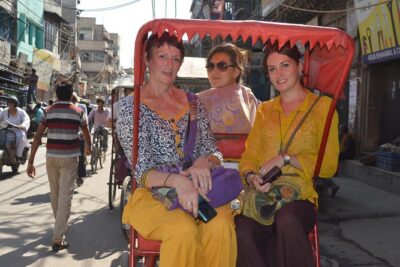
Old Delhi Food, Heritage&Cultural Walk with Rickshaw ride to Masterji Kee Haveli
Read our review →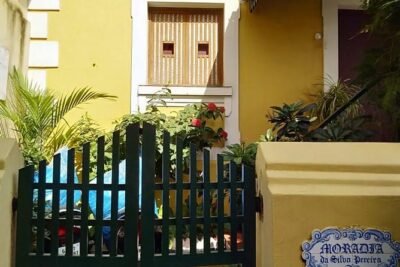
Fontainhas Heritage Walk At Latin Quarters of Goa
Read our review →Browse the lists this tour appears in