
Reviewed · WALKING TOURS
Mahabalipuram walking tour by tourism ministry approved company
Mahabalipuram is one of those rare places where stone architecture turns into storytelling. This guided walking tour takes you through key Pallava monuments in a UNESCO World Heritage Site, so you are not just looking at temples and caves, you are learning what you are seeing and why it mattered.
I love the small group size (a maximum of 15), because the guide can actually slow down when you have questions. I also love how the tour is guided by a real person who can explain the carvings clearly, and the name that pops up again and again is Ramesh.
The only real catch is time. With 10 stops in about 3 hours, you need to keep a steady pace and accept short viewing windows, especially in the heat.
Key highlights worth planning for
- Up to 15 people, so it feels personal instead of rushed
- Admission tickets included at each stop, saving hassle and time
- UNESCO Pallava sites, including rock-cut temples, bas-reliefs, and monolith “rathas”
- Walk or autorickshaw choices, so you can match your comfort level
- Ends at Five Rathas, useful if you want to keep exploring after the tour
- Mobile ticket, making check-in straightforward
Mahabalipuram’s Pallava stonework: why a guided walk is worth it
Mahabalipuram is often treated like a day trip, but the monuments deserve more than a quick photo stop. The heart of the visit is the 7th-century Pallava legacy, when artists carved whole temples and myth scenes directly into granite. When you are on your own, it is easy to miss what you are looking at, because the details are small, the meanings are layered, and the sites are spread out.
A good guide fixes that. Here, the focus is on helping you connect the visuals to the stories and the craftsmanship. You learn the basics of the Pallavas and how their builders shaped architecture and sculpture into one continuous language. The walking route also helps you notice changes in style from one cave or chariot temple to the next, instead of treating them as separate, unrelated attractions.
The best part is that you get to see the variety in a single half-day arc. You go from monolith structures (the rathas) to cave temples supported by pillars, then to giant bas-reliefs that cover entire walls. You also get myths from Hindu epics and major forms like Vishnu, Shiva, and Durga, all expressed through stone.
More Walking Tours in Chennai
- Gods of Mylapore walking tour- tourism ministry approved company
★ 5.0 · 267 reviews - Georgetown heritage walking tour in Chennai about the founding of Chennai
★ 5.0 · 144 reviews - Chennai Walking Tour ( 2 hours guided tour)
★ 3.8 · 85 reviews
Shore Temple meet-up to Five Rathas finish: how the timing feels
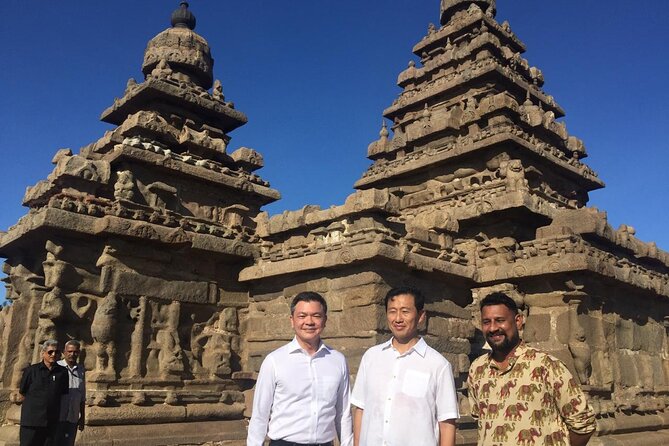
The tour starts at Mahabalipuram Shore Temple, Beach Rd, Mahabalipuram, and ends at Five Rathas (Pancha Rathas) on W Raja St. That end point matters, because Five Rathas is one of the most popular areas to revisit, and it is a natural place to continue on your own if you still have energy.
The total duration is about 3 hours. Each stop is typically around 15 to 20 minutes. That is enough time to understand what you are seeing and get a few good viewing angles, but not enough for hours-long “study sessions.” If you like to linger, plan to treat the tour as the guided orientation first, and then spend extra time afterward on your favorite stop.
You also have some flexibility in how you travel. The tour is built for people who want to walk, and it also allows autorickshaw options when it makes sense. That helps if you have a slower walking pace, or if the sun is doing its own aggressive schedule.
One more practical point: this area gets busy around the main monument sites. If you are arranging drop-off or pickup on your own, I recommend planning a slightly off-to-the-side location where you can meet the group without fighting crowd traffic.
Pancha Rathas first: the rock-cut “chariots” that set the tone
Stop 1 is Pancha Rathas, also called Five Rathas. This is where the tour makes its strongest promise: you are immediately in UNESCO territory with rock-cut monolith structures that look like stone chariots. Seeing them first is smart. They give you a baseline for how the Pallavas imagined architecture as sculpture, not just buildings.
Expect about 20 minutes here, which is just enough to take in the overall layout and start spotting carving patterns. The rathas are famous because they are carved from a single solid rock, and the proportions feel intentional and sculptural. With a guide, you also learn how to read the shapes more confidently, so your brain stops treating each temple like a random block of stone.
If you are someone who enjoys architecture basics, this start will click. You will start noticing structural ideas and decorative motifs right away, and that makes the later cave temples easier to understand.
Pancha Pandava Cave: the largest cave-temple and its yali guardians
Stop 2 is Pancha Pandava Cave, the largest cave-temple at Mahabalipuram. This one stands out because of its layout. The cave is supported on six pillars and two pilasters, and that gives it a strong rhythm even before you focus on the sculptures.
The real visual hook is the yali sculptures on the pillars. Yalis are mythical creatures, and here they act like stone guardians around the structure. When you understand that these carvings are part of the architectural frame, the cave stops being a dark room and becomes a designed space.
Plan for about 15 minutes. In that time, you should aim to find the pillars and take a slow look up and around, because the yali figures are the kind of detail you can miss if you only glance forward.
A different shape of Chennai day:
- Mahabalipuram tour by Tourism Ministry approved company
★ 5.0 · 405 reviews - Mahabalipuram & Kanchipuram by tourism ministry approved company
★ 5.0 · 264 reviews - Chennai tour in car with guide-winner of traveller’s choice award
★ 5.0 · 258 reviews - Mahabalipuram Private tour from Chennai by car with guide and lunch by Wonder
★ 5.0 · 137 reviews
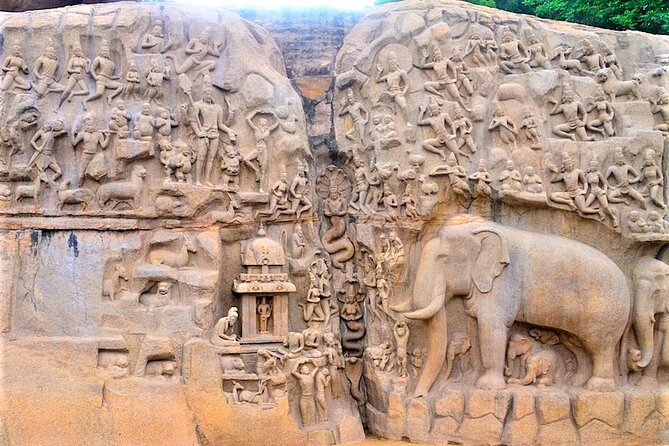
Arjuna’s Penance: a bas-relief wall built for epic storytelling
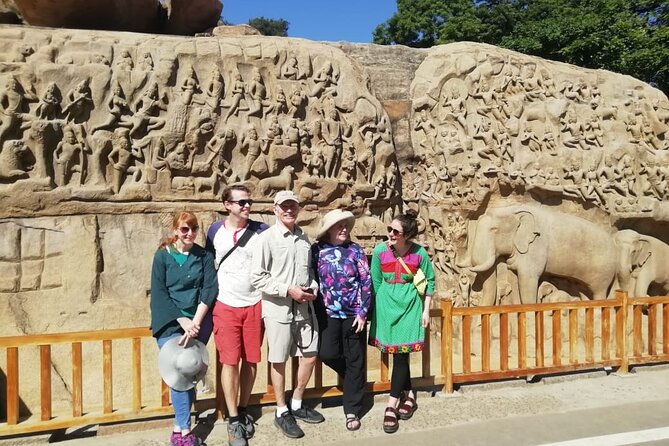
Stop 3 is Arjuna’s Penance, one of the biggest “wow” moments on the route. It is a bas-relief monument, and the scale is the first thing that lands. The relief is 100 feet long and 45 feet tall, with scenes from the Mahabharata carved into a long stone wall.
This is where I really like having a guide. Without one, you might notice the figures but miss how the scenes are arranged and what story beat you are looking at. With a guide, the carvings become sequential, so it feels less like scattered characters and more like a long narrative panel.
You will get about 20 minutes here. The trick is to resist the urge to only take one wide photo. If you can, step along the relief in your mind and focus on a section at a time. That is the fastest way to make the massive carving feel readable instead of overwhelming.
Krishna’s Butter Ball: the granite boulder that makes you question gravity
Stop 4 is Krishna’s Butter Ball. It is a granite boulder posed on a stony slope, and the claim is that it has not moved despite its precarious position. It is not just a quirky roadside myth. It works as a visual puzzle that makes you look at the engineering choices of the stone environment.
You get about 15 minutes here. That is just enough time to understand the visual idea, find a couple of angles, and move on before the group time slips.
If you like playful detours inside serious history, you will enjoy this stop. It gives your brain a break from temples and deep myth scenes, while still keeping you in the Mahabalipuram mindset.
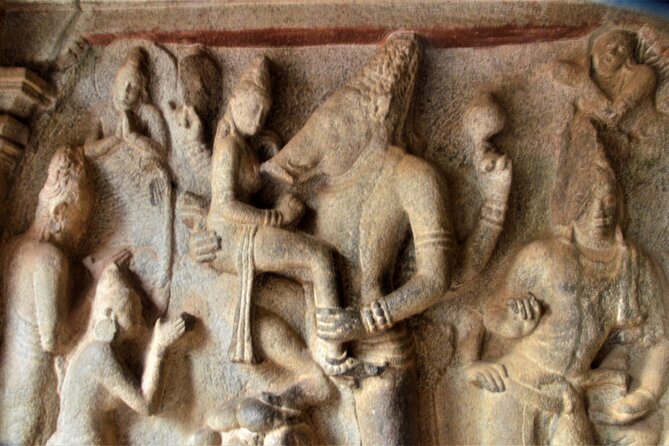
Varaha Cave Temple: 7th-century carving, lions at the pillars
Stop 5 is Varaha Cave Temple, carved out of a huge piece of granite and dating back to the 7th century. This is one of those sites where the age feels tangible because the stonework looks deliberate and heavy, like it took serious time and labor.
A key feature is the squatting lions adorning the pillars that support parts of the temple. They are not random decoration. In many South Indian stone traditions, lions signal power and protection around sacred spaces, and here you can see that role played out in the doorway and support structures.
You will have about 20 minutes. Use that time to locate where the lions sit in relation to entrances and pillars, so you can see how the animal forms frame the sacred architecture rather than acting like standalone statues.
Trimurti Cave: Brahma, Vishnu, Shiva in a single Pallava design
Stop 6 is Trimurti Cave, dedicated to the holy trinity of Hindu gods: Brahma, Vishnu, and Shiva. This stop is about recognizing how one space can hold multiple divine themes.
The cave is known for Pallava-style rock-cut architecture and for fine carvings of elephants. Elephants are a recurring symbol in many temple contexts, and here they appear as detailed decorative elements that make the cave feel alive, even though everything is carved from stone.
Plan for about 20 minutes. My advice: do not only look for the biggest figures. Scan for the animal carvings and smaller ornament details. That is where the “skill” side of Pallava carving becomes obvious.
Ganesh Ratha Temple: a single-stone chariot with a changed dedication
Stop 7 is Ganesh Ratha Temple, an imposing chariot carved out of a single stone. Originally dedicated to Lord Shiva, it later became associated with Lord Ganesh. That change in dedication is one of the interesting reminders that temple sites evolve over centuries, not just in the initial construction.
The tour also notes it was built in the 7th century by King Mahendravarman I. That helps anchor the site in a specific historical context, which makes the carvings feel less like anonymous ancient art.
You get about 15 minutes. Spend a bit of time focusing on the overall chariot shape, then look for how the space works for its deity association. Even with limited time, you can usually tell how the main figure or icon area is meant to be approached.
Old Light House built in 640: why a lighthouse belongs on a temple walk
Stop 8 is the Old Light House, built in the year 640. It is described as India’s oldest lighthouse and one of the oldest in the world. The tour ties it to Mahabalipuram’s role as a busy port since the 7th century, where the lighthouse helped keep mariners safe.
This stop is a smart balance. After caves and carvings, you get an anchor in daily life: shipping, coastline navigation, and why this place mattered beyond temples. It also broadens your understanding of why Pallava-era Mahabalipuram was not just a spiritual center, but also a working port.
You will have about 20 minutes. Treat it as a reminder that civilizations build multiple kinds of monuments. Some are made for worship. Some are made to guide people safely along the shore.
Mahishasura Mardini Cave: Vishnu resting and Durga fighting
Stop 9 is Mahishasura Mardini Cave. This cave has two imposing bas-reliefs. One shows Lord Vishnu sleeping on top of the coils of a serpent. The second shows Goddess Durga fighting the demon Mahishasura on a lion.
This is a powerful pairing. You see two different myth moods in one place. One side leans toward rest, cosmic order, and divine presence. The other side is action, battle, and the clash between good and evil, expressed in stone.
The tour schedules about 15 minutes. In that time, try to find both relief panels and compare their compositions. The guide can help you read the scene balance, so you understand how the artist creates drama and meaning through positioning.
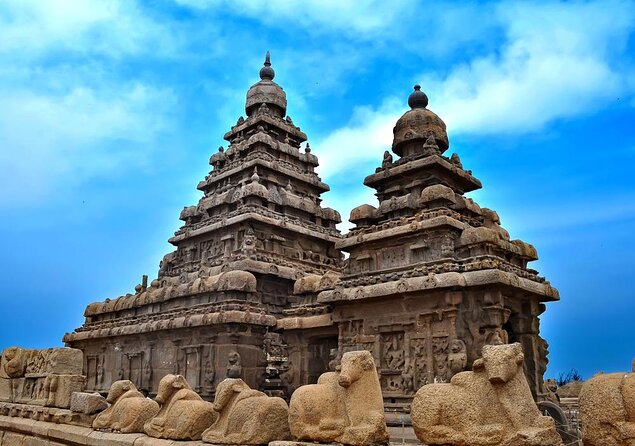
Shore Temple finale: Bay of Bengal views and Pallava port power
Stop 10 is Shore Temple, the last stop and a strong closer. The temple overlooks the Bay of Bengal, and it was an important center during the Pallavas when Mahabalipuram was their main port.
This is the stop where the setting starts to matter as much as the sculpture. Once you notice the coastline relationship, the whole tour reads differently. The temples are not floating in a vacuum. They are part of a working world, shaped by trade routes, sea travel, and the long reach of the Pallava court.
You get about 20 minutes here. Do not rush through it. Take a moment to look outward toward the sea, even if it is just for your perspective. Then return to the temple for the architectural details the guide points out.
Price and value for a $50 half-day tour with tickets included
At $50 per person for a roughly 3-hour guided route, this tour lands in the “solid value” category, mainly because admission tickets are included at each stop. That matters because the total cost of entry fees can add up fast when you are hopping between monuments.
The small group size also helps justify the price. With a maximum of 15 people, you spend more time interacting with the guide and less time waiting behind a crowd.
There are also group discounts mentioned, which can make it even better if you are traveling with friends or family. Add in the mobile ticket, and the day feels smoother from start to finish.
I would consider this price especially fair if you want real interpretation, not just a checklist of sights. If you are the kind of visitor who likes to understand what you are looking at, guided time is where your money goes.
Why Ramesh-style guidance changes what you see
The strongest consistent theme in the experience is the guide. Ramesh comes up with high praise for being enthusiastic, flexible, and clear. He is described as a guide who explains Pallava carvings and construction techniques in a way that feels like storytelling, not lectures.
That matters because Mahabalipuram is a place where visuals can look similar if you do not have context. When the guide connects the carvings to their themes and explains the craftsmanship, each stop stops blending into the next.
Another practical win: the tour can run in a way that feels responsive to the group. There is mention of the tour being extended by an extra hour, which tells me the guide is not just reading a script and moving on. If your group wants a bit more time at a highlight, there is a chance to get it.
Practical tips so you stay comfortable during a 10-stop route
Mahabalipuram walking is very doable for most people on the tour, but you still want to plan for heat and sun. Wear comfortable shoes with decent grip, because you will likely move over uneven outdoor stone and paths.
Bring water. Yes, it sounds obvious, but the route hits multiple rock-cut sites, and the sun can make you feel drier than you expect.
If you are concerned about pacing, use the tour’s built-in flexibility. The tour allows you to visit on foot or by autorickshaw, so you can choose what fits your energy. It is also smart to expect short viewing windows and to prioritize angles. One good angle beats five rushed ones.
Finally, keep logistics simple. The start and end points are different, so plan transport accordingly. If you are staying in Chennai, you will likely coordinate a day trip. Locally, aim to meet and depart at calmer spots rather than right on top of the busiest entry lanes.
Should you book this Mahabalipuram walking tour?
Book it if you want a guided, high-signal way to see the Pallava monuments at Mahabalipuram in about half a day. The combination of small group attention, included admission, and a guide who can explain carvings and techniques makes the difference between seeing temples and understanding them.
Skip it if you hate set schedules, need long stop times, or prefer to wander without any historical context. This is built for a 10-stop circuit, so it will not feel like a slow, self-paced museum day.
If you do book, pick your favorite 2 or 3 monuments in advance. Then plan to return to those after the tour on your own, so you get both the guidance and the freedom.
FAQ
How long is the Mahabalipuram walking tour?
The tour lasts about 3 hours.
How big is the group?
The maximum group size is 15 travelers.
What is included with the tour price?
Admission tickets are included for the stops on the itinerary, and you get a mobile ticket.
Where does the tour start and end?
Start is Mahabalipuram Shore Temple, Beach Rd, Mahabalipuram. The walk ends at Five Rathas (Pancha Rathas), 58 W Raja St, Mahabalipuram.
Is the tour dependent on weather?
Yes. This experience requires good weather, and if it is canceled due to poor weather, you will be offered another date or a full refund.
Can I get a full refund if I cancel?
You can cancel for a full refund if you cancel up to 24 hours in advance of the experience start time. If you cancel less than 24 hours before, the amount paid is not refunded.
Latest reviews in from Chennai
- Marina Beach walking tour by tourism ministry approved company★ 5.0 · 45 reviews
- Following the foot steps of St Thomas in Chennai★ 5.0 · 45 reviews
- Private Peacock Trail Walking Tour in Mylapore★ 5.0 · 50 reviews
- British Architecture Walk, an immersive walking tour in Chennai★ 5.0 · 60 reviews
- Private Bazaar Trail Walking Tour in George Town★ 5.0 · 66 reviews
- Full-Day Private Tour to the Kanchipuram Temples from Chennai★ 5.0 · 73 reviews
- Total Chennai city tour in Private car with guide & lunch by Wonder tours★ 5.0 · 79 reviews
- Sowcarpet Street Food Walking Tour in Chennai with guide★ 5.0 · 83 reviews
Walking Tours, compared.


The Great Indian Food Tour: Old Delhi Food and Heritage Walk
Read our review →

Old Delhi Food, Heritage&Cultural Walk with Rickshaw ride to Masterji Kee Haveli
Read our review →
Fontainhas Heritage Walk At Latin Quarters of Goa
Read our review →Browse the lists this tour appears in