
Reviewed · HERITAGE WALKS
Colonial Heritage Walking Tour in Darjeeling
This colonial heritage walk is interesting because it strings together Darjeeling’s British-era institutions, then slows down for places where faith, photos, and local life show up side by side. I like how the tour starts at the Clock Tower area and uses simple landmarks to explain the city’s layout and power centers. I also like the stop at Das Studio, one of the oldest photography places in town, where old pictures help you see Darjeeling across different eras.
One possible drawback: it’s a real walking tour with multiple short stops, so if you hate moving from place to place, you may wish for more time in fewer spots. And since this experience is weather dependent, plan for a jacket and a flexible attitude.
Key Things to Know Before You Go
- Clock Tower, then clubs and offices, so the colonial story feels practical, not like a textbook
- Keventer’s and Glenary’s are built in, with time at a viewpoint and a classic tea-time hangout
- You’ll mix faith stops (St. Andrews Church plus a temple) so Darjeeling isn’t only defined by British influence
- Old photos are a core part, especially at Das Studio, where you can compare views from different years
- Museums and memorials add context, including Tibetan history themes and a remembrance tied to India’s independence movement
- Group size stays reasonable, with a cap of 50 people, and you get a professional guide
Where Darjeeling’s Colonial Story Shows Up On Foot
Darjeeling can feel like a mountain town that grew in layers. This tour helps you read those layers without getting lost. The route stays focused on the British period and its aftermath, but it never treats Darjeeling as a closed chapter. It keeps bringing you back to everyday spots where history is still visible.
I like that the pacing supports both first-timers and repeat visitors. You’re not asked to do a “see everything” marathon. Instead, you get a sequence of recognizable landmarks, then brief windows to look, take photos, and buy small things if you want to.
At about 2 to 3 hours, this is also the kind of activity that works well between other plans. If you’re sightseeing around the Mall area, this walk gives you a structure. If you’re new to Darjeeling, it can help you understand why the town feels like it does, from civic buildings to clubs to viewpoints.
The price is $27.97 per person, which is not tiny, but it starts to make sense because the experience includes all fees and taxes and covers multiple paid stops during the walk. You’re also not paying out of pocket for every entry ticket you encounter. For a short tour with a guide and several included visits, that’s solid value.
More Heritage Walks in Darjeeling:
- Fontainhas Heritage Walk by Make It Happen
★ 5.0 · 2,834 reviews - The Great Indian Food Tour: Old Delhi Food and Heritage Walk
★ 5.0 · 1,698 reviews - Old Goa Heritage Walk by Make It Happen
★ 5.0 · 797 reviews
Starting at the 1850 Clock Tower
You begin at Limbugaon, Darjeeling, and the walk kicks off at the Darjeeling Clock Tower, built in the 1850s. The tower is tied to the Town Hall, and the landmark quality matters. Early on, it tells you where civic life was organized and how the British-influenced urban planning shaped the town center.
This is a good first stop because you get an immediate “anchor.” Instead of starting with a random building, you start with something that still controls the feeling of the area.
What to watch for: since the tour is weather dependent, early morning or cloudy conditions can make photos tricky. If the sky looks flat, focus on the architecture and details rather than expecting dramatic views.
Planters Club and Gymkhana: The Colonial Social Scene
Next you move into two of the big colonial-era club stories: the Darjeeling Planters Club and the Darjeeling Gymkhana Club.
The Planters Club traces back to 1868, when it was set up for British planters and their families. Even if you don’t care about club culture, this stop explains how colonial power worked beyond government buildings. It shows that social spaces were also political spaces. The tour frames this not as gossip, but as how community life and authority were built.
Then comes the Gymkhana Club, established in 1909. This one is useful because it gives you a sense of day-to-day recreation, not only formal history. The club is described with facilities like badminton courts, card rooms, and an excellent library. That mix is telling. It’s one thing to hear about the British in Darjeeling. It’s another to see how they structured leisure.
Practical note: these stops are time-limited. You’ll get a short visit window, so take photos quickly and use the guide’s explanations to get more meaning out of what you see.
Head Post Office, a Small Building With Big Timelines
The walk includes the Darjeeling Head Post Office, built in May 1921. It’s described as one of the oldest post offices of the region, and it’s also labeled as a UNESCO World Heritage Site.
Why this matters on foot: post offices are easy to ignore when you’re sightseeing. But they connect trade, communication, and administration. In Darjeeling’s case, that becomes part of why the town mattered in the first place.
If you’re the kind of traveler who likes practical history, this stop is a keeper. You can think of it as infrastructure that helped tie the hill station into wider networks.
More Walking Tours in Darjeeling:
- Group Guided Walking Tour in Fort and Colaba
★ 5.0 · 1,073 reviews - Spiritual City Walking Tour-THE Pushkar Route
★ 5.0 · 907 reviews - Private Guided Walking Tour in Fort & Colaba
★ 5.0 · 895 reviews
Keventer’s Viewpoint Break: Classic Hill-Station Nostalgia
Time at Keventer’s is included, and the description is specific about what you’ll get. It’s framed as a nostalgic reminder tied to Mr. Edward Keventer’s dairy farm of Ghoom, and the stop is positioned near an iconic viewpoint in the middle of town.
This is one of the most relaxing parts of the walk because it’s not just looking at stone and plaques. You’re given time to sit, eat something if you want, and enjoy the view. For me, this type of break is key on a heritage tour. It keeps the day from becoming only facts and footnotes.
If you’re trying to keep costs down, you can also treat this as a view stop, not a food stop. Still, since admission is included here, you’ll likely want to sample something while you’re there.
Glenary’s for Sunset Time and a Local Hangout Feel
Another included stop is Glenary’s, described as a bakery, restaurant, and pub. It was once founded by an Austrian in Darjeeling, and the setting is tied to one of the best sunset moments in town.
Even with a short stop, Glenary’s is a smart point in the walk because it shifts from colonial institutions into everyday life. It also gives you a place to recharge before you continue toward the churches, museums, and market areas.
If the weather is gloomy, you might not get a full sunset moment. Don’t stress. The point here is the town’s social rhythm, and the building and café vibe still work.
St. Andrews Church and Dhirdham Temple: Faith as Architecture
Darjeeling’s spiritual side shows up in two styles: a British Anglican church and a temple influenced by Nepali architecture.
At St. Andrews Church, the tour notes an original build date of 1843 and ties it to Lt. Gen A Lyod, believed to be the discoverer of Darjeeling. It’s also described as an Anglican church along the Mall Road. If you want a quick visual marker of British presence, this church is it.
Then, near the railway station, you’ll visit Dhirdham Temple, described as built in a style similar to Katmandu’s Pashupatinath temple. That’s useful because it shows how Darjeeling’s religious architecture adapts to local and regional influences, not only colonial ones.
What to do with these stops: look past the exterior and focus on how the buildings communicate different identities. Churches like this often feel formal and linear. Temples like Dhirdham feel more symbolic and patterned. The guide’s context helps you connect style to meaning.
Mall Road Stops: Government House (Raj Bhavan) and the Town Center
The walk reaches Darjeeling Mall, which matters because it’s the “main line” for much of the old power and winter-capital logic. The tour describes the Government House as Raj Bhavan, initially built by the British in 1840. Later, in 1877, ownership shifted to the Maharaja of Cooch Behar.
This stop is a turning point in your understanding. You’ve seen social clubs. You’ve seen civic buildings. Now you see where the winter capital energy and administration would have concentrated.
Even if you only get a brief look, this is one of those locations where it helps to imagine the town when it was at full winter season intensity. That mental image makes the rest of the walk click.
Das Studio: Old Photos That Make Time Real
A standout for many people is Das Studio, one of the oldest photography studios in Darjeeling, started in 1927. The walls are decorated with panoramic photographs of the city from different periods.
This is where you get something more than facts. Photos turn history into a visual comparison. Instead of thinking about colonial-era Darjeeling as an idea, you can compare street-level impressions across years.
Tip: if you have any interest in photography, spend your moment carefully. Take in the angles and the repeated landmarks. Even a short photo gallery can teach you where the town’s visual priorities were.
Markets and Books: Where You Can Make the Story Personal
The walk includes quick stops for shopping and local texture, with a couple that are especially good if you like browsing:
- Habeeb Mullick & Sons (estd 1890), described as a top place for handcrafted curios
- Oxford Book and Stationery Co., with hill-style cottage architecture and an extensive selection of souvenirs
These stops are short, which is good. It keeps you from losing the narrative focus. But they still let you bring something home that feels connected to what you just learned.
If you’re budget-minded, treat these as browsing only. If you find something small and meaningful, you’ll already be in the right mood for a purchase.
Railway-Time History: Darjeeling’s Himalayan Railway Moment
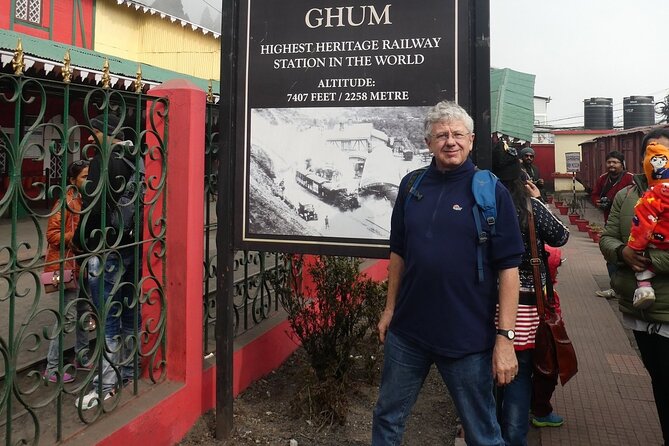
Darjeeling’s identity is tied to rail, and the tour includes time connected to the Darjeeling Himalayan Railway, which started its journey in the 1870s.
This matters because the railway is more than transport. In hill stations, it’s often the engine that makes growth possible. It affects tourism, trade, and the way people experience the town.
If you like technical history, you might want to do additional reading later. But even a short included stop gives you a useful anchor for the rest of the colonial narrative.
Old Market, Ropeway Area Vibes, and Memorial Context
The walk moves toward Old Market, described as the heart area for the Old British Market, Old Railway Station, and the old British Ropeway.
Even if you only spend a short period here, this kind of location works because it’s practical. Old transport hubs are where commerce and daily life braided together.
The tour also includes a stop at the Chittaranjan Das Memorial, tied to a legendary figure in India’s Independence Movement. That’s an important reminder. Colonial Darjeeling is not only about British presence. It’s also about Indian resistance, identity, and the long push toward independence.
Museums and Hayden Hall: Tibetan Links and Women’s Enterprise
Two included indoor-style stops add depth beyond architecture.
First is the Himalayan Tibet Museum, described as a repository of accounts related to Tibetan indigenous history and the centuries-old relationship between Tibet and India. This is a smart contrast to the British-era buildings. Darjeeling’s location means it absorbs cross-border influences, and the museum helps you see that clearly.
Second is Hayden Hall, described as a place to explore the history of the Hayden Hall Institute and its enterprising women. The emphasis on women’s work and institutions adds a needed balance to many heritage tours that focus only on men, politics, or military power.
If you’re the type who can get museum-fatigue, don’t panic. The stop timings are built in so you won’t feel stuck for hours.
A Short Look at the Town, Then Time to Continue On Your Own
The tour also includes time that leaves room for shopping and exploring. That matters because once you understand what you’re looking at, you often want to go back and see it again without a schedule telling you to move on.
By the end, you’re positioned near St. Andrews Church (the end point is given as a specific location by Chauk Bazaar). That’s a decent spot to keep wandering on foot, grab a second snack, or connect to other parts of town.
Price, Duration, and Value You Can Feel
Let’s talk value, because this tour sits in a common dilemma. Heritage walks can be underwhelming if the guide time is short and everything becomes “look at the sign, move on.” Here, the included admissions and multiple meaningful stops improve the odds.
What you get for $27.97:
- A professional guide
- A walk of about 2 to 3 hours
- A set of included visits with fees and taxes covered
- A couple of built-in breaks where you can take in Darjeeling’s food and viewpoint culture, including Keventer’s and Glenary’s
- A stop at Das Studio with old-photo context
- Museum time, plus memorial and church or temple visits
Group size is capped at 50, which keeps it from feeling like a human parade. You’ll still be in a group, so if you want quiet one-on-one attention, you’ll need to choose your expectations accordingly.
Best timing: since it’s weather dependent, choose a day when you expect clearer conditions. If clouds roll in, the historical buildings still hold their charm, but outdoor photos and view time may be less dramatic.
Who Should Book This Tour (and Who Might Skip It)
Book it if:
- You want a guided way to understand colonial-era Darjeeling without reading a pile of books
- You like visual learning, especially through old photos at Das Studio
- You want both British-era landmarks and spiritual stops, including St. Andrews Church and Dhirdham Temple
- You appreciate a tour that includes time to sit and eat, not only stand and listen
Skip it if:
- You hate short stops and prefer long hangs in one neighborhood
- You only want sweeping scenery and are less interested in institutions, museums, and architecture
- Your day is locked to a very strict schedule, because the walk depends on good weather
Should You Book This Colonial Heritage Walking Tour?
If you want a clear, efficient introduction to Darjeeling, I think this is a good pick. It connects civic power, social club culture, religious architecture, and museums in a way that makes the city easier to understand fast. The value is strongest when you like included admissions, appreciate historical context, and enjoy a mix of photo stops, indoor spaces, and café breaks.
If you’re already deeply familiar with Darjeeling’s colonial details, you might treat it as a refresher plus a good afternoon structure. But for most first-timers, it’s a practical way to get oriented and leave with memories that feel specific, not generic.
FAQ
How long is the Colonial Heritage Walking Tour in Darjeeling?
It runs about 2 to 3 hours.
Where does the tour start and where does it end?
It starts at Limbugaon, Darjeeling, West Bengal 734101, India and ends at St. Andrews Church (27X8+4QG), Chauk Bazaar, Darjeeling, West Bengal 734101, India.
Do I get a mobile ticket?
Yes, the tour includes a mobile ticket.
What is included in the price?
The price includes all fees and taxes. The tour also lists multiple stops where admission or ticket time is included.
Are there food stops like Keventer’s and Glenary’s?
Yes. Keventer’s and Glenary’s are both included stops, with time built in for you to enjoy what they offer.
How large is the group?
The tour has a maximum of 50 travelers. Service animals are allowed.
What happens if the weather is poor?
The experience requires good weather. If it’s canceled due to poor weather, you’ll be offered a different date or a full refund.
What is the cancellation cutoff for a full refund?
You can cancel for a full refund if you cancel at least 24 hours in advance of the experience start time. If you cancel less than 24 hours before, you don’t get a refund.
More Historical Tours in Darjeeling
- Old Delhi Food, Heritage&Cultural Walk with Rickshaw ride to Masterji Kee Haveli
★ 5.0 · 742 reviews - Fontainhas Heritage Walk At Latin Quarters of Goa
★ 5.0 · 531 reviews - Blue City Heritage Private Walking Tour With Pickup and Drop-Off
★ 5.0 · 441 reviews - Kolkata Heritage Tram Tour
★ 4.0 · 395 reviews
Latest reviews in from Darjeeling
- Day_Trippers (Darjeeling Full Day Tour).★ 5.0 · 54 reviews
- 4Nights 5Days Sikkim Package★ 4.5 · 114 reviews
- Sikkim Darjeeling – North East India 7 Nights 8 Days Tour★ 4.5 · 56 reviews
- Singalila Ridge Trek from Darjeeling – 6 Days★ 5.0 · 56 reviews
- Darjeeling Tonglu Day Trek★ 5.0 · 62 reviews
- Singalila Trek from Darjeeling★ 5.0 · 79 reviews
Heritage Walks, compared.

The Great Indian Food Tour: Old Delhi Food and Heritage Walk
Read our review →
Fontainhas Heritage Walk At Latin Quarters of Goa
Read our review →
Private Heritage Walking Tour in Jaisalmer Fort and Old Bazaar
Read our review →
Browse the lists this tour appears in