
Reviewed · DHARAVI TOURS
Private City Tour with Dharavi Slum Dhobighat and Dabbawalla
What makes this Mumbai day tour interesting is the way it links major landmarks with lived-in neighborhood stops, especially Dharavi and Dhobi Ghat. I also like that the tour experience is built around a steady, human guide, often called Siddhi or Sid, so the day feels less like a checklist and more like a guided walkthrough of how the city ticks.
One possible drawback: it is a 6 to 7 hour full-day route, and part of that time is spent in places where the atmosphere can feel intense. Go with the right mindset, keep things respectful, and plan on a long sit-free day.
Key things you’ll care about
- Private group pace for a route that mixes top sights with real neighborhood stops
- Siddhi, often called Sid, highlighted for a careful, people-first approach
- Dharavi for around 2 hours, not a quick drive-by
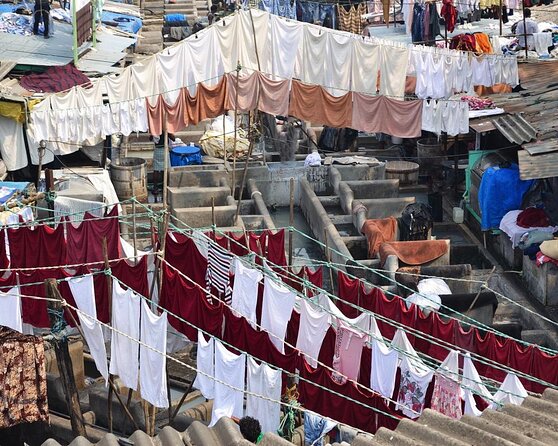
- Dhobi Ghat around 30 minutes, an open-air laundry stop tied to Mahalaxmi railway area
- A classic South Mumbai arc, from Gateway of India and Marine Drive to UNESCO Chhatrapati Shivaji Terminus
- Most stops listed as admission ticket-free, which helps keep costs predictable
A Mumbai day that links landmarks to everyday life
This isn’t only about seeing Mumbai from a postcard angle. It also tries to explain Mumbai from the ground up, from monumental buildings to working spaces. You start in Colaba, work your way through the grand architecture and famous promenades, then shift into a very different kind of Mumbai when Dhobi Ghat and Dharavi come into view.
I like that the tour is built like a straight line across South Mumbai and then pushes you into the Dharavi side at the end. That structure matters. You are not zigzagging all day. You spend your time moving through neighborhoods and key sites, not crisscrossing traffic for random detours.
And the guide is a big part of the value. The strongest signal from past guests is not just facts, it is how the explanation lands, with empathy and a sensitive tone. That makes the difference when a tour includes places where people live their day-to-day lives.
More City Tours in Mumbai
- Mumbai City of Dreams Tour in Private Vehicle
★ 5.0 · 299 reviews - Mumbai: Guided City Sightseeing Tour
★ 4.8 · 278 reviews - Mumbai City Sightseeing Small Group Tour
★ 5.0 · 216 reviews
How the schedule works, from 9:30 am Colaba to Dharavi drop-off
Your day starts at 9:30 am at Regal Cinema, Apollo Bandar, Colaba. From there, the route runs for about 6 to 7 hours, with multiple stops that are timed in small chunks. That is intentional. You get several “look and learn” moments without the day turning into one long wait.
Pickup is included as an option, and the tour offers a mobile ticket. You will want to set expectations that you are signing up for a full day, not a short hit-and-run. Also, the tour runs under the condition of good weather, so if the forecast looks rough, you may be asked to shift dates.
Finally, the ending point is listed as Kumbhar Wada, Dharavi. If you like to end your day near public transit or a specific neighborhood plan, this matters for how you’ll build the rest of your evening.
Colaba to the legal and university belt: Gateway of India, library, and Bombay High Court
The first major stop is Gateway of India, a landmark built in the early 20th century to commemorate the landing of King-Emperor George V. Even if you have seen photos before, this is the kind of place where you can quickly understand why Mumbai’s waterfront became the stage for big moments.
From there, you move into the University of Mumbai Library area and the High Court Principal Bench Bombay stop. These are short stops on paper, but that is exactly the point. You are getting a fast orientation to the power centers of the city, the institutions that shape education and law. If you like a city day that explains how modern Mumbai functions, these brief pauses help your brain place the later sights in context.
A practical consideration here: these are not “wander for hours” stops. The value is in what the guide points out while you’re there. If you prefer long self-guided time, you might feel the pace, especially early in the morning.
UNESCO rail drama at Chhatrapati Shivaji Terminus, then markets and Marine Drive
Next up is Chhatrapati Shivaji Terminus, a historic railway terminus and a UNESCO World Heritage Site. This is one of those stops where the building itself does a lot of talking. It is easy to underestimate how emotional a transportation hub can be until you stand close and see the details.
After that, you head to Crawford Market. The market building was completed in 1869, and it is donated to the city by Cowasji Jehangir. Markets are where Mumbai’s energy becomes visible fast. Even if you do not buy anything, you can feel the motion and understand why this kind of place is still essential.
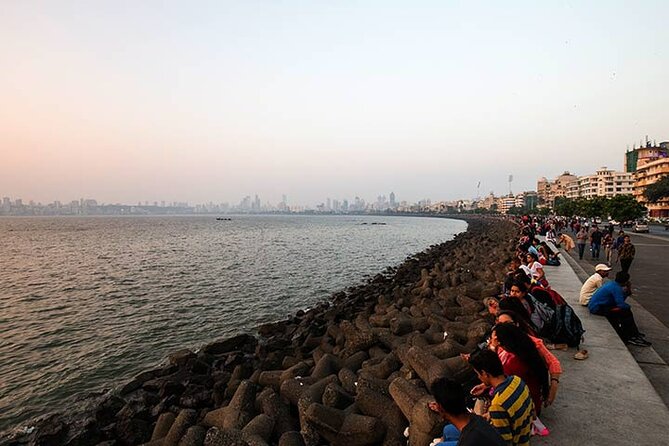
The day then softens into views at Marine Drive, a 3 kilometer promenade along Netaji Subhash Chandra Bose Road. Marine Drive’s curved layout gives it a “cinema frame” feel at golden hour, and it also works as a breathing space after rail-station intensity and market chaos.
If you are traveling with a camera, this section is where you’ll likely want it most. If you are sensitive to crowds, I recommend you use the guide-led timing here and let them steer you to the best angles without you getting stuck.
Other Dharavi walks:
- Dharavi slum tour in Mumbai by Female tour guides of the slum
★ 5.0 · 1,976 reviews - Mumbai: Dharavi Slum, DhobiGhat, and Dabbawallas Tour
★ 4.9 · 689 reviews - Dharavi Slum Tour
★ 5.0 · 625 reviews - Dharavi Slum tour in Mumbai by local resident
★ 5.0 · 572 reviews
Gandhi’s Mani Bhavan, Hanging Gardens, and the view from Kamala Nehru Park
In the middle of the day, you shift to Mani Bhavan Gandhi Museum, a museum and historic building dedicated to Gandhi at Laburnum Road in the Gamdevi precinct. It is described as the focal point of Gandhi’s political activities in Mumbai, and that makes it more than a quick photo stop. You are learning why certain places matter to the city’s moral and political story.
Then comes Hanging Gardens at Malabar Hill, also known as Pherozeshah Mehta Gardens. Terraced gardens perched on a hilltop give you a different angle on Mumbai, literally. Next is Kamala Nehru Park, built in 1952, with a viewpoint over Marine Drive.
These viewpoint stops are valuable because they break the day up visually. You go from street-level buildings to hill-level sightlines. You get a sense of scale that you cannot easily get from the waterfront alone.
One note: parks on hills can be sun-heavy. If you run hot, plan to take short shade breaks whenever the guide pauses.
Banganga Tank and Antilia: sacred water and billionaires row side by side
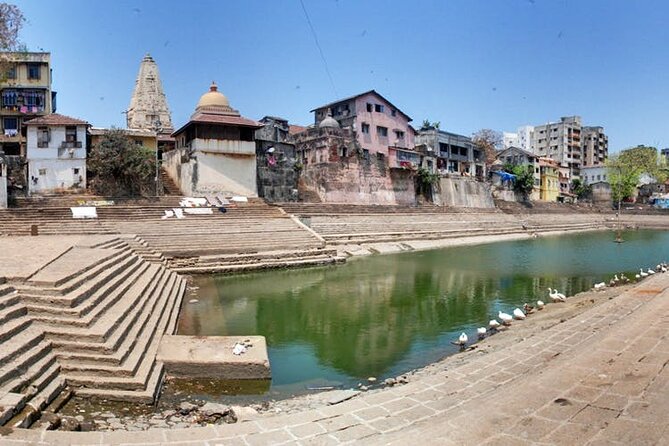
At Banganga, you visit the Banganga Tank, a temple tank part of the Hindu Walkeshwar Temple complex in Malabar Hill. A tank stop sounds small on a schedule, but it is actually a useful contrast to the modern institutions earlier in the day. It adds a spiritual layer to the route.
Then the tour takes a sharp turn in tone at Antilia, described as a private residence in the billionaires row of Mumbai, named after the mythical island Antillia. It is the residence of Mukesh Ambani and his family, who moved into it in 2012.
This is an important moment for anyone trying to understand Mumbai’s range. The point is not to reduce it to money glamour versus poverty pain. It is to show how close different realities can be. The route sets you up for what comes next, because it raises your awareness of inequality before you reach the neighborhood stops that carry that theme much more directly.
If you are uncomfortable with wealth-as-spectacle, you might still find this stop useful for understanding the geography of power.
Dhobi Ghat and the Dharavi core: the two stops you should plan for mentally
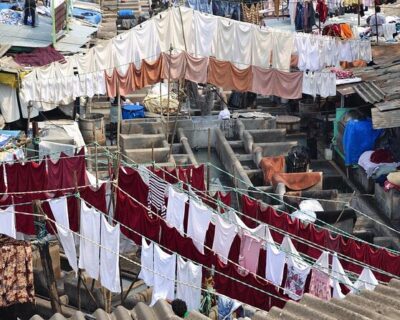
This is the heart of the tour. Dhobi Ghat is described as an open-air laundry place at Mahalaxmi railway station in southern Mumbai, and it is also accessible from Jacob Circle monorail station. The tour budgets about 30 minutes here, which is enough time to see how the work is organized and why the location matters.
Then you go to Dharavi, a locality described as one of the world’s largest slums. The provided details put numbers on that: about 2.1 square kilometers and a population around 1,000,000. The tour sets aside around 2 hours for Dharavi, which is crucial. That length suggests the guide intends to slow down, explain, and let you process rather than just speed through.
I like that the tour does not treat Dharavi as a two-minute shock photo stop. The timing gives the day room to make sense, especially after you have already seen the institutional and wealth markers earlier.
Dhobi Ghat to Churchgate, then into Dharavi
Between the laundry stop and Dharavi, you also visit Churchgate Railway Station and the nearby seaside area. Churchgate is described as known for sports grounds like Oval Maidan and Brabourne Stadium, with neo-Gothic and art deco style nearby. This section gives you a breather, plus it shows another kind of Mumbai public life.
Then the tour transitions to Kumbhar Wada, Dharavi as the end point. Even if your night plans are outside Dharavi, this ending spot is practical. It drops you right where the local neighborhood geography is.
Why the guide style makes or breaks this kind of tour
With a route that includes Dharavi, guide tone is everything. This tour is tied to a guide experience that stands out for a few concrete things.
First, there is a clear track record of professional, personalized guidance. Second, past guests repeatedly highlight a human and sensitive approach, which is exactly what you want when a tour enters people’s daily spaces. Third, communication before the tour seems to be handled well, including messaging through email and WhatsApp, so you are less likely to show up confused or late.
I also like that flexibility comes up in the guide pattern. One big complaint about some city tours is the rigid script. Here, some guests reported the guide adapting when they wanted to skip a place or add something else. That can matter in a city like Mumbai, where timing and traffic can make a strict plan feel theoretical.
There is another quiet value point: one guest specifically called out that the guide emphasized you do not have to buy anything, unlike some tours that feel pushy. That matters, especially around markets and neighborhood stops, where sales pressure can otherwise ruin the experience.
Price and value: what $75.69 per person really buys you
The price is $75.69 per person for a private 6 to 7 hour day. That sounds simple until you break down what you get.
You are paying for:
- A private route, so you are not stuck with other people’s pacing
- Pickup offered (as listed), which saves your energy at the start
- A tight set of major South Mumbai landmarks, including a UNESCO site and multiple notable architecture stops
- Two high-impact neighborhood experiences, Dhobi Ghat and Dharavi, with real time allocated at each
- A guide who, based on reported patterns, focuses on respectful explanation rather than sales pressure
Also, many stops are listed as admission ticket-free in the schedule. That helps your budget because you are not suddenly hit with gate fees at every turn.
One more “value math” factor: this tour is often booked about 78 days in advance on average. Popular days fill up. If you wait, you may lose the guide you want or the timing you prefer.
Who this tour fits best
This tour is a strong match if you want:
- A single-day overview of Mumbai that goes beyond monuments
- A route that includes both architecture and neighborhood life, with time built in for both
- A guide-first experience, where questions and context matter
It may be less ideal if you want a mostly relaxing sightseeing day, with lots of free wandering. The schedule is structured, and the day is long. Also, Dharavi content can be emotionally heavy, even when handled respectfully.
Should you book this private Mumbai tour?
Yes, if you want a Mumbai day that connects famous places to how people live and work. The best reason to book is the balance: you see major South Mumbai landmarks, then you spend meaningful time at Dhobi Ghat and Dharavi. The second reason is the guide pattern, with Siddhi or Sid highlighted for a professional, sensitive, no-pushy tone.
Skip it only if you know you cannot handle intense realities for long stretches, or if you prefer a lighter day with more unstructured time. For most first-time visitors who want to understand Mumbai in one go, this is a smart bet.
FAQ
What are the start and end points of the tour?
The tour starts at Regal Cinema, Apollo Bandar, Colaba, Mumbai, and ends at Kumbhar Wada, Dharavi, Mumbai.
What time does the tour begin?
The start time is listed as 9:30 am.
How long is the tour?
The duration is listed as about 6 to 7 hours.
Is this a private tour or shared group?
It is a private tour/activity, meaning only your group participates.
Is pickup included?
Pickup is offered.
Do I get a mobile ticket?
Yes, a mobile ticket is included.
Which major stops does the tour include?
The listed stops include Gateway of India, University of Mumbai Library, Bombay High Court (Principal Bench), Chhatrapati Shivaji Terminus, Crawford Market, Marine Drive, Mani Bhavan Gandhi Museum, Hanging Gardens, Kamala Nehru Park, Banganga, Antilia, Dhobi Ghat, Churchgate Railway Station, and Dharavi.
Is there any admission cost during the tour?
The schedule lists admission ticket free for the stops shown in the itinerary.
What weather does the tour require?
The experience requires good weather.
What is the cancellation rule?
You can cancel up to 24 hours in advance for a full refund. If you cancel less than 24 hours before the start time, the amount paid will not be refunded. If the tour is canceled due to poor weather, you will be offered a different date or a full refund. If the minimum number of travelers is not met, you will be offered a different date or experience, or a full refund.
Latest reviews in from Mumbai
- Premium Mumbai Sightseeing Tour★ 5.0 · 16 reviews
- Small-Group Bike Tour of Mumbai★ 5.0 · 16 reviews
- Cruise to Mumbai Historical Tour★ 5.0 · 16 reviews
- 3 Hours Early Morning in South Mumbai Heritage Bicycle Tour★ 4.5 · 16 reviews
- Bollywood Studio Tour with Guide and Transport★ 5.0 · 16 reviews
- Bollywood Sightseeing and Celebrity Homes Tour by Private Car★ 5.0 · 16 reviews
- Private Slum tour With Bollywood and Stars Home★ 5.0 · 16 reviews
- Same Day Taj Mahal and Agra Tour from Mumbai with Return Flights★ 4.5 · 16 reviews
Dharavi Tours, compared.
Dharavi slum tour in Mumbai by Female tour guides of the slum
Read our review →

Dharavi Slum Slumdog Millionaire Tour with a Local
Read our review →
Dhobi Ghat Laundry and Dharavi Slum Tour with Local
Read our review →
Browse the lists this tour appears in