
Reviewed · FATEHPUR SIKRI DAY TRIPS
Agra To Jaipur Drop Via Fatehpur Sikri & Chand Baori, Step Well
An Agra to Jaipur travel day becomes real sightseeing when you break it up at Fatehpur Sikri and the Chand Baori stepwell. I like this setup because you get a private, air-conditioned car from pickup to drop, and you do not waste time figuring out tickets or logistics. The day is built to flow from one UNESCO-style stop to the next, without turning it into a stressful scramble.
My favorite part is the focus on guided visits at both major sites, which helps you read what you are looking at instead of just taking photos. The main drawback is timing and comfort: the whole day runs about 8 hours, and if you travel with lots of luggage, you may find the car feels tight for the drive and transfers.
Key highlights you should care about
- Private A/C car door-to-door from anywhere in Agra to anywhere in Jaipur
- English-speaking guides at Fatehpur Sikri and the stepwell stop
- UNESCO-listed Fatehpur Sikri with a long list of Mughal landmarks to see
- Chand Baori (Abhaneri), famous for its deep, geometric stair layout
- Mobile ticket for an easier check-in day
- Pro tips that matter: wear proper footwear for stairs, and expect goats around the stepwell area
Turning an Agra to Jaipur ride into two heritage stops
This is not just a point-to-point transfer. It is a planned, private route that swaps boring transit time for two of north India’s most visually dramatic sites. You leave Agra with a driver and car, then your stops do the storytelling for you.
You’ll have a pickup available from practically anywhere in Agra, including hotels, railway stations, the airport, and addresses you choose. At the end, you get dropped at your preferred location in Jaipur, whether that is a hotel, a train station, or somewhere in between.
With a group size of up to 2 in a private vehicle, this works especially well if you want control over pace. You can also treat the guided portions as your “anchor” time, then spend a little extra time where you personally care most.
More Fatehpur Sikri day trips:
- Private Transfer Agra to Jaipur with Fatehpur Sikri
★ 5.0 · 135 reviews - Private Transfer From Agra To Jaipur with Fatehpur Sikri
★ 5.0 · 117 reviews - Agra: Guided Tour of Taj Mahal, Agra Fort and Fatehpur Sikri
★ 4.7 · 81 reviews
Pickup in Agra: easy start, then you’re on the clock
The schedule begins with pickup in Agra and then transitions into the first major stop. You have about an hour at the start, which is useful because you can get settled, confirm details with your driver, and ease into the day before the sightseeing begins.
One practical detail I like: the experience is built to be private, so you are not waiting for other people to arrive. That usually helps a lot when you are trying to manage heat, rest breaks, and photo stops.
A small note on communication: your driver is there to get you safely from place to place. English-speaking guides are included for the sightseeing stops, so if your driver’s English is limited, it is not a deal breaker for the main parts of the day.
Fatehpur Sikri: Mughal power, red sandstone scale, and a lot of different buildings
Fatehpur Sikri is your main time block, with about 2 hours on-site. The plan focuses on visiting all areas with an English-speaking guide, so you get explanations rather than just roaming.
I really like that Fatehpur Sikri is not treated as a single “must-see” photo spot. It is handled like a real imperial city, and the itinerary hits many of the landmarks people come for.
Here are the highlights, in plain terms, and why they matter:
The royal entrance, Shahi Darwaza
The Shahi Darwaza Gate is the kind of structure you notice even from a distance. It is described as a royal entrance for the emperor and his court, and the carvings are meant to show authority and prestige.
Even if you only have 2 hours, this gives you a sense of how the site worked as a ceremonial space, not just a collection of monuments.
Line these Agra options up side by side
- From Delhi: Taj Mahal Sunrise, Baby Taj & Agra Fort Day Tour
★ 4.9 · 2,020 reviews - Agra: Skip-the-Line Taj Mahal & Agra Fort Private Tour
★ 4.9 · 1,546 reviews - Agra: Taj Mahal Express Entry Tickets
★ 4.8 · 684 reviews - Agra: Taj Mahal and Mausoleum Guided Tour with Skip-the-Line
★ 4.8 · 631 reviews
Turkish Sultana’s House, Indo-Turkish styling
This residence is called the Turkish Sultana’s House, and it is identified with Indo-Turkish architectural styling, including arches and detailed decoration. It helps you understand that Mughal architecture was not isolated, it borrowed and blended ideas.
When a guide walks you through these stylistic choices, it makes the buildings feel less random and more intentional.
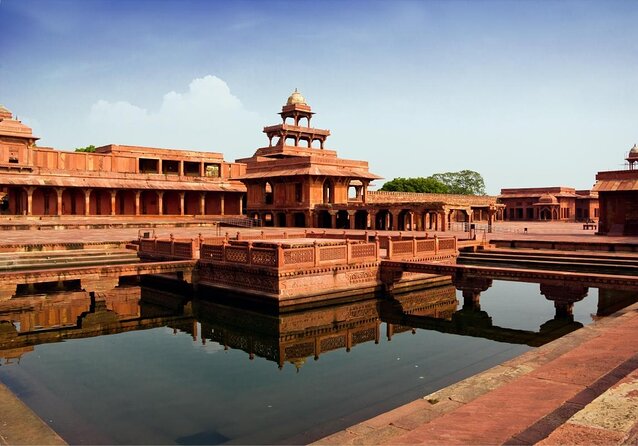
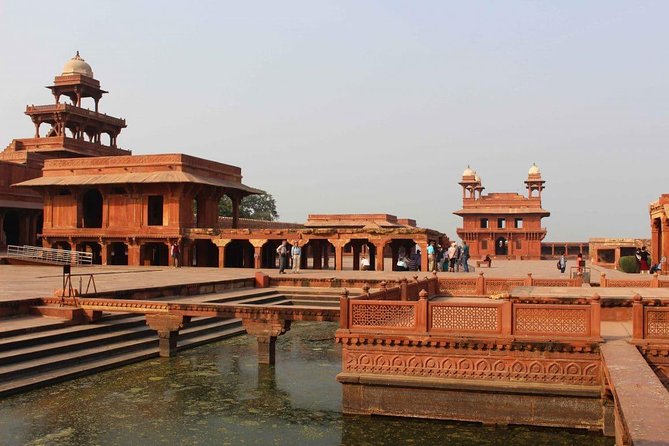
Panch Mahal: airy pavilion, five levels of leisure
The Panch Mahal is a five-story, open-pillared pavilion, designed as a leisure space for royal women. The open structure also means you may catch breezes and get better sightlines for photos, depending on the time of day.
If you like architecture and symmetry, this stop usually feels rewarding.
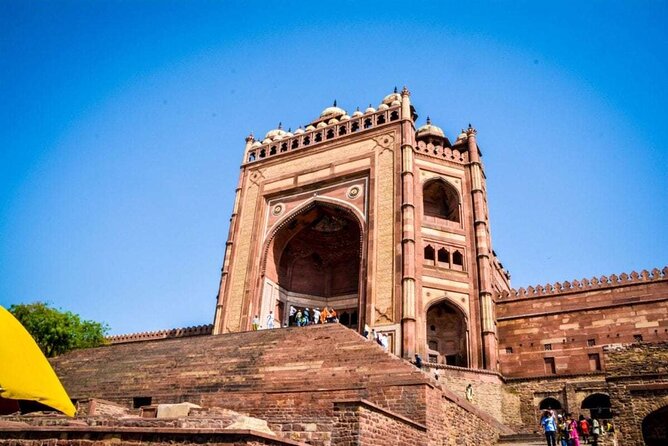
Buland Darwaza, Akbar’s monumental gateway
Buland Darwaza is built by Akbar in 1601 and is listed at about 54 meters high. That is the sort of scale that makes you stop walking and look up, even if you think you have seen big gates before.
This is also the easiest building to use as a “wow marker” for the whole visit. You walk in, you look up, and your brain instantly gets the size of the empire being projected.
Khazana and the treasury mystery
The Khazana, or treasury, is described as three rooms used for storing imperial valuables or documents. It was also wrongly called Ankh Michauli, which is a fun reminder that even famous sites can have name confusion attached to them over time.
A guide can turn that into a story of how people label places once official context fades.
Caravan Sarai: trade and travel in the imperial city
Near Hiran Minar, you visit the Caravan Sarai, described as a resting place for traveling merchants and caravans. This is a nice correction to the usual “palaces only” impression.
It helps you picture Fatehpur Sikri as a place where commerce and movement mattered, not just royal rituals.
Fort wall, long boundary and protection
The fort wall stretches nearly 6 kilometers and encloses the Mughal city. The idea here is defense plus a majestic boundary, and the red sandstone construction signals the permanence they wanted.
If you like planning and fortifications, this is a good segment to focus on because it changes the mood from ornamental to strategic.
Diwan-i-Aam and the idea of public audience
Diwan-i-Aam is described as the hall for public audience where Akbar addressed grievances. That framing, public address inside an imperial complex, makes the site feel more human.
Your guide should connect the architecture to the political message.
Hathi Pol: elephant gate
Hathi Pol, or Elephant Gate, is a grand entrance built wide enough for royal elephants to pass. It is an architectural detail that tells you how the court functioned and how transport and display were built into the city plan.
It is also a great place for a quick photo because the structure reads well even in a short stop.
Hiran Minar: a tower for memory and affection
Hiran Minar is a tall tower built by Akbar in memory of his favorite elephant. That unusual purpose helps Fatehpur Sikri feel less like cold stone and more like personal court history.
If you are paying attention, this is one of the places where a guide’s explanations can change your entire reaction to the building.
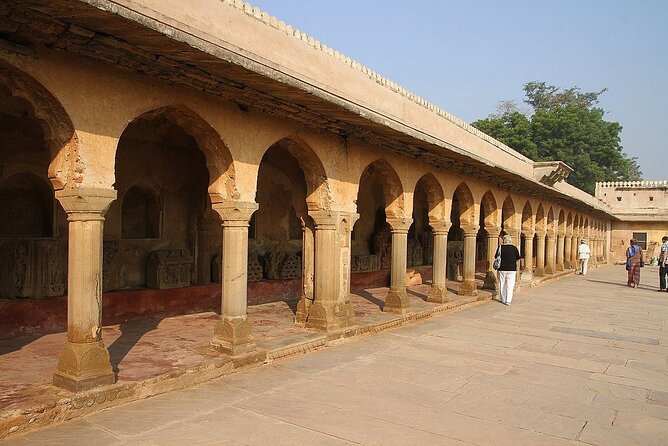
The palace-adjacent porches and Birbal Bhavan
The itinerary also mentions an arcaded porch complex that some think may be stables, plus Birbal Bhavan near Jodha Bai’s Palace. Birbal Bhavan is described as a residence with elegant carvings and symmetry, believed to be tied to Birbal, Akbar’s trusted minister.
This is the kind of segment where you either enjoy detective-style interpretation, or you tune in just enough to keep the overall layout in mind.
Sheikh Salim Chishti’s white marble tomb
You also visit the beautiful tomb of Sheikh Salim Chishti, described as white marble with precious gems and stones. That visual shift, white marble in a broader red sandstone world, tends to be a highlight for many people.
If the day is hot, marble can feel like a relief, too.
Jama Masjid: large scale and Persian-inspired motifs
Jama Masjid is described as one of the largest mosques in India, built by Akbar in 1571. The guide portion should help you notice the Persian-inspired motifs and the bigger meaning of the mosque within the complex.
Jodha Bai’s Palace and blended styles
Jodha Bai’s Palace blends Rajput and Mughal styles, with spacious courtyards and richly carved motifs. It is built for Akbar’s queen, and the architecture reflects cultural harmony.
This is a strong stop if you want to understand how empire worked through relationships, not only conquest.
Diwan-i-Khas, Diwan-i-Aam’s private cousin
Diwan-i-Khas is described as famed for a central intricately carved pillar with radiating stone bridges, symbolizing Akbar’s vision of unity. It was used for private audiences and discussions.
If Diwan-i-Aam is “public voice,” Diwan-i-Khas is “inner circle,” and the contrast is the point.
Anup Talao and Khwabgah: pools and private chambers
Anup Talao is an ornamental pool surrounded by pavilions, used for musical performances and royal gatherings. Khwabgah, the House of Dreams, is Akbar’s private chamber for rest and reflection, with richly decorated interiors.
These are the stops that can make the site feel like a living court, even though the city is long gone.
One real-world guide name to look out for
One Fatehpur Sikri guide mentioned is Abid (Tony). If you get a guide like that, you’ll likely enjoy how they make the monuments feel connected instead of just listed.
A cautious note on the guides and the pace
In theory, everything is covered with English-speaking guides. In practice, guide energy can vary, especially for smaller or more remote areas later in the route.
For Fatehpur Sikri, you should feel in good hands, and the site’s layout gives you plenty to focus on. For the stepwell, I suggest you come with a couple of questions in mind, so even if your guide’s talk time is shorter, you still get meaning from the visit.
Also, plan for heat. The schedule can be intense, and you will likely do your best work when you pace yourself at shaded points and save your best photos for moments when you can stand comfortably.
Chand Baori at Abhaneri: the stepwell that plays with your sense of space
Chand Baori in Abhaneri is a major contrast after the Mughal city. This is where the day turns geometric, quiet, and surprisingly dramatic.
You get about 30 minutes here, and that is enough if you focus on the core experience: the symmetrical stair layout and the depth. The stepwell is described as built over 1,000 years ago and as one of the deepest stepwells in the world.
What you should do with your 30 minutes
- Walk in to get your first real view of the depth and symmetry.
- Spend time looking up and down the stair lines. The design makes optical illusions, and you will “feel” the scale more than you can measure it.
- If you want photos, pick angles that show repetition in the steps.
Wear proper footwear, and yes, watch the goats
One of the clearest on-the-ground tips is to wear proper footwear so you can navigate the stairs without slipping or getting sore feet. Another practical note: mind the goats around the stepwell area.
This is not a museum floor. It is an active site with uneven surfaces and animals nearby, so good shoes matter.
The drive time: comfortable A/C, plus a note on luggage
The transfer runs long enough that comfort matters. This is in a private air-conditioned vehicle, and the driver typically stays with you through the day while you tour the sites.
A real-life consideration from past guests: some people arrived with a lot of luggage and found the sedan size limiting. For two people, there are still only so many seats and trunks in a typical sedan, so if you are traveling with 8-plus bags, you should flag that in advance.
If you pack lighter, the drive is usually easier to enjoy.
Lunch and rest breaks: plan for food on your own
Food and drinks are not included. That means any lunch stop you make along the way is your responsibility.
In one example, a lunch pause happened during the transfer, and the price was higher than expected. The practical takeaway is simple: when you stop to eat, choose where you want to eat, not where the first convenience option points you.
Even if you do not love the lunch spot, you still gain value from having controlled, timed sightseeing blocks.
How much is this really worth?
At $146.06 per group (up to 2), you are paying for a private, door-to-door car, plus entry tickets and English-speaking guides at the key sites. For an Agra to Jaipur day, that adds up quickly if you try to hire and coordinate everything on your own.
The value is strongest if you:
- want a low-stress way to reach Jaipur
- care about history enough to want guided explanations
- prefer staying in one vehicle instead of managing multiple taxis and ticket lines
The value is weaker if you already plan to do the stops yourself with minimal need for a guide. In that case, you might find cheaper options, but you would spend more time managing details.
Who this tour suits best
This is a great fit for couples or solo travelers who want a private ride and guided site time without spending extra effort on planning. It also suits people with limited time in Agra and Jaipur who still want more than just a quick look at monuments.
If you love architecture, geometry, and Mughal-era design, you will likely enjoy how the day moves from Fatehpur Sikri’s monumental gateways to Chand Baori’s stair-depth illusion.
If you are extremely sensitive to tight seating, bring fewer bags and keep expectations realistic about the sedan size.
Should you book this Agra to Jaipur route with Fatehpur Sikri and Chand Baori?
Book it if you want a structured, private heritage day where you get guided context at the two biggest stops and a comfortable A/C transfer that ends with a drop exactly where you want in Jaipur.
Skip or adjust expectations if you hate stairs, travel with a huge amount of luggage, or prefer a slower, more flexible sightseeing rhythm. The plan is efficient, and that efficiency can feel fast if you want to linger for long.
Overall, if your goal is to convert your transit day into two meaningful stops without the headaches, this is a strong choice.
FAQ
What is included in the price?
It includes Agra to Jaipur private transfers, entry tickets, and an English-speaking tour guide.
How long is the experience?
It runs about 8 hours total, including time at each stop.
Is this tour private or shared?
It is private. Only your group participates.
Where are pickup and drop-off locations?
Pickup is available from any location in Agra, including hotels, railway stations, the airport, restaurants, or your address. Drop-off is available anywhere in Jaipur, including hotels, railway stations, the airport, restaurants, or your preferred address.
Which sites do we visit?
You visit Fatehpur Sikri and Chand Baori (Abhaneri stepwell) on the way from Agra to Jaipur.
Are the entry tickets and guides included at the attractions?
Yes. Entry tickets are included, and English-speaking guided tours are included for the Fatehpur Sikri stop.
Is food included?
No. Food and drinks are not included.
Do I get a ticket on my phone?
Yes. The experience includes a mobile ticket.
Is there free cancellation?
Yes, free cancellation is available. You can cancel up to 24 hours in advance for a full refund.
Latest reviews in from Agra
- From Agra Private Transfers to Wildlife SOS Elephant Conservation★ 5.0 · 49 reviews
- Same Day tour from delhi Agra private cab★ 5.0 · 127 reviews
- Taj Mahal Skip-the-Line Guided Tour with Multiple Options★ 5.0 · 212 reviews
- Taj Mahal: Express Entry Ticket For Sunrise Tour with guide★ 4.9 · 299 reviews
- Agra: Skip-the-Line Taj Mahal & Agra Fort Private Tour★ 5.0 · 124 reviews
- Taj Mahal Half Day Tour by Tuk Tuk★ 5.0 · 16 reviews
- Day Trip Delhi to Agra by Express Train in 90 Min★ 5.0 · 43 reviews
- Private Transfer From Agra To Jaipur with Fatehpur Sikri★ 5.0 · 117 reviews
Fatehpur Sikri Day Trips, compared.

Private Transfer Agra to Jaipur with Fatehpur Sikri
Read our review →
Private Transfer From Agra To Jaipur with Fatehpur Sikri
Read our review →
Guided Tour of Taj Mahal, Agra Fort and Fatehpur Sikri
Read our review →
Private Transfer From Jaipur to Agra including Fatehpur Sikri
Read our review →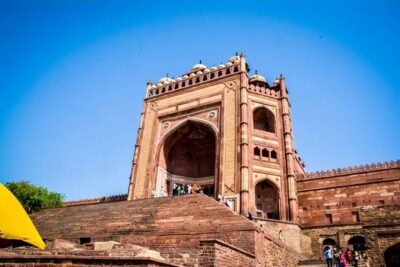
Private Fatehpur Sikri Tour sightseeing All Inclusive
Read our review →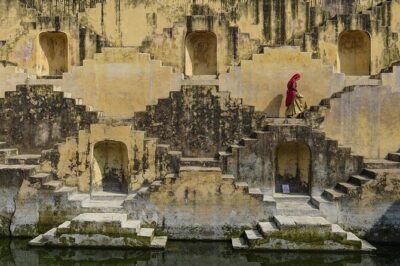
Private Transfer Agra To Jaipur Via Fatehpur Sikri & Chand Baori, Step Well
Read our review →
Browse the lists this tour appears in